From Mistakes to Mastery: How Interactive Displays Support Hands-On STEM Learning
Dec 17, 2025
In STEM education, learning rarely follows a straight line. Experiments fail, assumptions are challenged, and results do not always match expectations. Yet these moments of error are often where the most meaningful learning begins.
In physics classrooms especially, abstract concepts such as electrical circuits, polarity, and current flow can be difficult to grasp through theory alone. Hands-on experimentation allows students to see cause and effect directly—but only when the learning process itself is visible, guided, and supported.
This is where interactive display solutions play an increasingly important role.
Why Mistakes Matter in STEM Learning
Traditional classroom experiments often focus on achieving the “correct” outcome. However, in real scientific practice, mistakes are part of discovery. A wire connected to the wrong terminal, an unexpected reaction, or a failed setup all provide opportunities for analysis and understanding.
When students are encouraged to observe what went wrong—and why—it strengthens problem-solving skills, critical thinking, and scientific reasoning. The challenge for educators is making these moments clear, safe, and instructive rather than confusing or discouraging.
Making the Learning Process Visible
Interactive displays help transform experiments from isolated actions into shared learning experiences.
By combining physical experiments with digital visualization, teachers can:
Highlight each step of an experiment in real time
Annotate circuit diagrams and results directly on screen
Pause, review, and correct setups together with students
Compare expected outcomes with actual results
This approach shifts the focus from simply “getting the right answer” to understanding the process behind it.
Interactive Displays as Teaching Tools, Not Just Screens
In a hands-on STEM classroom, the role of display technology extends beyond presentation.
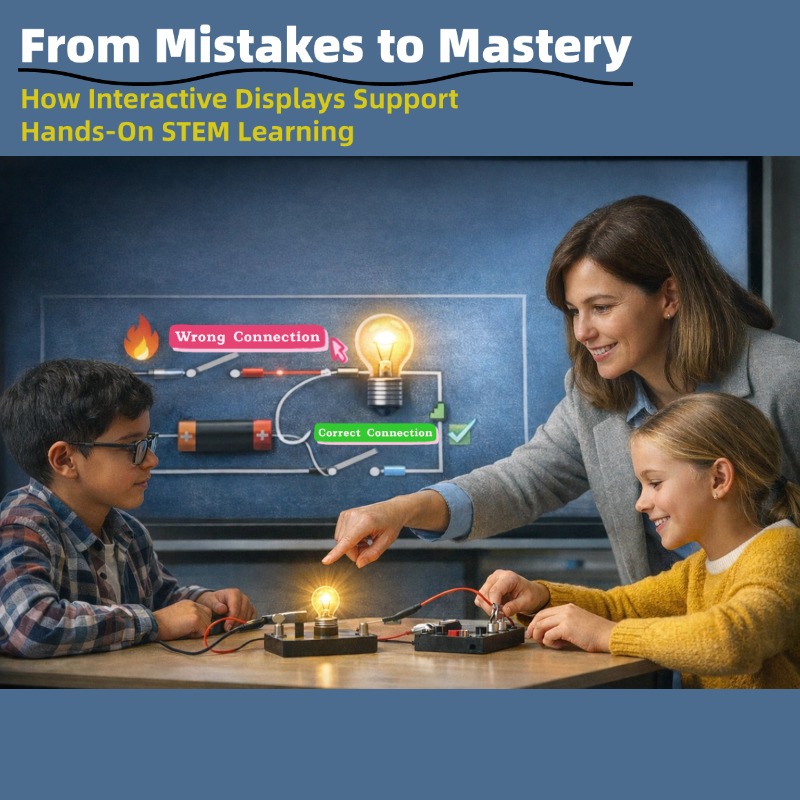
Solutions such as PRIMA Smart Blackboard, used together with UboardMate CC, enable teachers to integrate live experimentation with digital instruction. Physical components—wires, bulbs, batteries, and switches—can be supported by on-screen explanations, annotations, and structured guidance.
When a mistake occurs, it becomes a teaching moment rather than a disruption. Students can clearly see what caused the issue, how it was corrected, and what principle was involved. Over time, this reinforces both conceptual understanding and practical skills.
Supporting Safer, More Engaging Experiments
STEM education often involves real equipment, which introduces both technical and safety considerations. Interactive display systems allow teachers to:
Demonstrate correct setups before hands-on work begins
Guide corrections immediately when issues arise
Reduce repeated trial-and-error risks
Maintain student engagement without unnecessary interruptions
By structuring experimentation through a shared visual platform, classrooms become more controlled, efficient, and effective learning environments.
What This Means for Schools and Education Providers
For schools, system integrators, and education decision-makers, the goal is not to add more technology—but to support better teaching outcomes.
Interactive displays, when applied thoughtfully, help:
Enhance STEM curriculum delivery
Improve classroom interaction and student participation
Support inquiry-based and project-based learning models
Align physical experimentation with digital instruction
Rather than replacing traditional teaching methods, these tools strengthen them.
From Errors to Understanding
In STEM education, mastery does not come from avoiding mistakes—it comes from understanding them.
By making experiments visible, interactive, and collaborative, display solutions help turn errors into insights and challenges into learning opportunities. As classrooms continue to evolve, the focus remains the same: supporting educators and students in learning not just what works, but why it works.
Read More
 Web
Web





 IPv6 network supported