What Are You Looking For?
 Web
Web
 Web
Web
In our previous discussion, we explored how the rapid evolution of Android operating systems and edge-AI integration is shifting the procurement landscape. B2B buyers are no longer just purchasing screens; they are investing in long-term hardware chassis designed to survive the next 3 to 5 years of software development.
Today, we look at how this forward-looking engineering philosophy translates into physical hardware. Enter the PRIMA SG23 Series—a next-generation intelligent digital signage terminal specifically engineered to bridge the gap between heavy commercial demands and future-ready software compatibility.
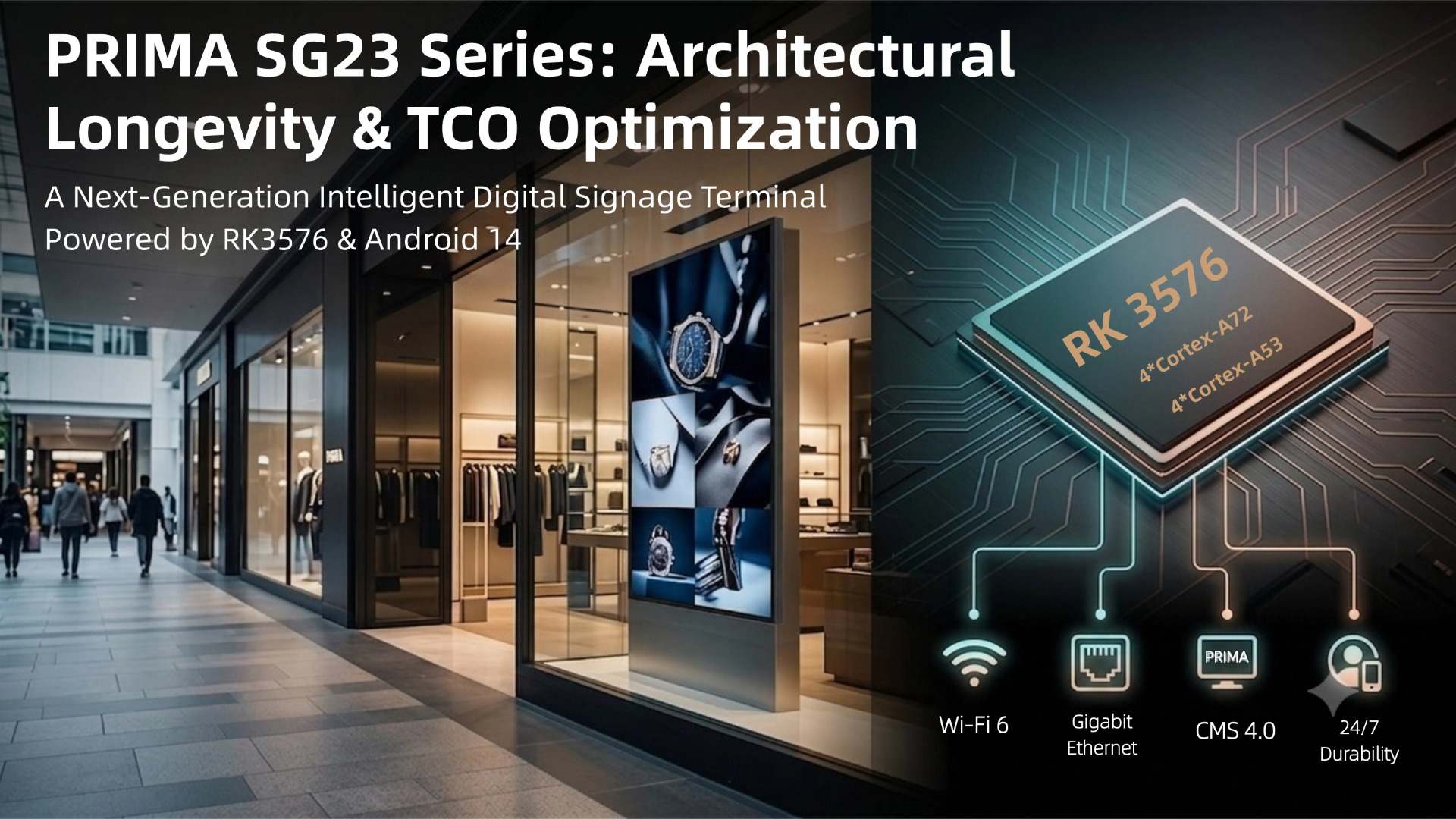
At the heart of the SG23 Series lies a powerful processing foundation: the Rockchip RK3576 octa-core processor (comprising 4 x Cortex-A72 and 4 x Cortex-A53 cores), paired natively with Android 14.
In the commercial display sector, many legacy media players still run on outdated, low-tier quad-core chipsets that struggle with modern web-based widgets and high-bitrate 4K decoding. The SG23’s robust octa-core architecture, backed by 4GB RAM and 32GB ROM, provides the exact computational redundancy required for smooth multitasking and seamless transitions. Furthermore, with integrated Wi-Fi 6 and Gigabit Ethernet, the SG23 is built to handle the massive data loads of modern, dynamic content delivery networks without latency.
Hardware is only as good as the software that manages it. To eliminate the operational complexity often associated with multi-screen deployments, the SG23 series features our proprietary PRIMA CMS 4.0 platform.
Consumer-grade TVs fail rapidly when subjected to the harsh, continuous-use demands of commercial spaces. The SG23 is purpose-built for enterprise-level durability:
Whether deployed in portrait or landscape, from its elegant 11.5mm 4-sided equal bezel to its robust internal architecture, the PRIMA SG23 series represents the ideal sweet spot of cost-to-performance ratio for modern digital signage networks. By deploying the SG23, system integrators and IT directors can deliver immediate, high-performance visual experiences today, confident in the knowledge that their hardware assets are fully equipped to adapt to tomorrow's software innovations.
A: Standard quad-core processors quickly bottleneck when forced to run modern CMS platforms that require simultaneous HTML5 rendering, live database querying, and background data synchronization. The RK3576's octa-core architecture distributes these processing loads across dedicated performance and efficiency cores, preventing system lag and reducing software-related crashes over long-term deployments.
A: Unlike cheap commercial displays or consumer TVs with poor thermal ventilation, the SG23 features a precision-engineered, heavy-duty metal backplate that acts as a direct passive radiator. By quickly dissipating heat away from the backlight board and power units, it prevents thermal buildup, protects the liquid crystals from heat-induced degradation, and extends the overall life of the panel.
A: Leveraging the modern architecture of Android 14 paired with PRIMA CMS 4.0, IT administrators can execute remote OTA firmware updates, monitor screen status in real-time, configure automated on/off schedules, and receive instant diagnostic logs without deploying a physical service team—minimizing unnecessary truck rolls and drastically reducing ongoing maintenance overhead.




 IPv6 network supported