Beyond the Spec Sheet: 3 Critical Factors for Institutional IFPD Procurement in 2026
Jun 03, 2026
The global interactive display market has entered a massive structural replacement cycle. Educational institutions and corporate enterprises that deployed their first-generation interactive flat panels (IFPDs) roughly five years ago are now facing an inevitable hardware refresh. However, the commercial landscape in 2026 has fundamentally shifted away from traditional hardware metrics. Procurement committees, Chief Information Officers (CIOs), and the system integrators who serve them are finding that comparing basic core speeds, raw storage numbers, and resolution values no longer guarantees a sustainable return on investment.
For institutional buyers, the true metrics of success are now measured in long-term platform viability, bulletproof network security compliance, and operational efficiency. For system integrators, winning long-term service contracts depends on deploying solutions that minimize post-sale troubleshooting and hardware obsolescence. To navigate this evolving landscape, hardware evaluation must focus on three core infrastructural elements that directly control the total cost of ownership (TCO).
1. The Operating System Baseline: Mitigating Premature Technical Obsolescence
Historically, one of the primary drivers of inflated TCO in enterprise and educational tech has been fragmented software lifecycles. Panels built on outdated, static Android baselines frequently experience rapid application incompatibility. As mainstream unified communications (UC) software and learning management systems (LMS) update their minimum system requirements, older panels lose functionality, forcing institutions into expensive, premature hardware replacements.
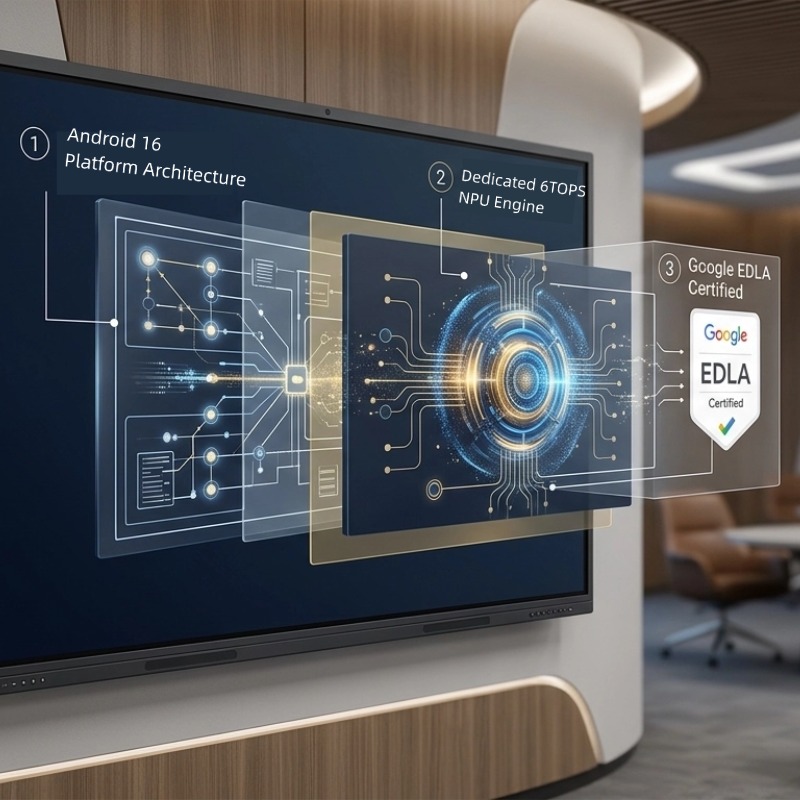
Deploying a native Android 16 platform architecture provides a critical safeguard for hardware investments. This modern framework introduces advanced native memory management and optimized thread scheduling, ensuring that complex, multi-layered enterprise applications run efficiently without degradation over a multi-year deployment cycle.
Procurement Pain Point (Schools & Enterprises)
Integrator Operational Benefit
Rapid depreciation due to software freezes and app incompatibility.
Drastically reduced post-sale service tickets and truck rolls related to firmware patches.
System slowdowns during intensive multi-tasking or hybrid sessions.
A robust, modern baseline that simplifies third-party software integration and validation.
By centering the product ecosystem around Android 16, PRIMA provides system integrators with a reliable, highly competitive platform that directly answers the institutional demand for long-term operational stability.
2. The Compliance Gateway: Google EDLA as a Hard Requirement
In modern campus and corporate network configurations, uncertified hardware represents an unacceptable security liability. IT administrators frequently block unauthorized devices that rely on unverified, sideloaded APKs because they lack centralized patch management and enterprise credential protection. Consequently, official Google EDLA (Enterprise Device Licensing Agreement) certification has shifted from an optional feature to an essential network entry requirement.
EDLA certification ensures strict compliance with Google's enterprise security protocols, including continuous credential encryption and verified app behavior. This certification guarantees smooth, official access to the Google Workspace ecosystem, enabling teachers and corporate leaders to log into Google Drive, Docs, and Google Classroom natively with complete account security.
Native Google Play Store Access: Users can safely download and update certified applications directly on the display, protecting the institutional network from unauthorized software vulnerabilities.
Centralized Management System (CMS) Integration: Enterprise IT teams can seamlessly enroll, configure, and monitor panels across multiple facilities using an integrated Centralized Management System (CMS), allowing for remote firmware deployment, automated scheduling, and centralized policy enforcement.
Reduced Deployment Obstacles: Integrators bypass lengthy security evaluations during the bidding phase, accelerating project completion and improving cash flow.
3. Dedicated Edge-AI Hardware: Shifting Architecture from CPU to NPU
Modern smart environments require complex, concurrent computational processing. Real-time handwriting vectorization, multi-device screen casting, active noise suppression, and camera framing must operate smoothly and simultaneously. In legacy hardware, these tasks run directly on the CPU, causing high thermal spikes, system throttling, and noticeable input lag.
The solution requires a dedicated hardware engine designed for artificial intelligence tasks. Integrating an efficient, dedicated 6TOPS Neural Processing Unit (NPU)—such as the architecture inside the Rockchip RK3576 platform—fundamentally redefines system performance. The NPU isolates specialized algorithmic tasks away from the primary compute cores, ensuring that the touch interface remains highly responsive and lag-free, even during intensive data processing.
Hardware Component
Functional Workload Allocation
End-User Experience Impact
Primary CPU Cores
Handles core operating system threads, application logic, and storage data formatting.
Fast application launching and smooth multi-window software navigation.
Dedicated 6TOPS NPU
Processes handwriting interpretation, optical character recognition, smart gesture controls, and audio-visual tracking algorithms.
Ultra-low latency whiteboarding and accurate real-time annotation with multiple concurrent users.
By choosing an NPU-driven design, integrators can confidently pitch an advanced system that guarantees long-term operational speed without complex hardware modifications or supplemental cooling solutions.
Strategic Engineering Tailored for Diverse Market Demands
As a dedicated B2B commercial display manufacturer, PRIMA structures its component engineering to align directly with specific target markets and commercial tiers. We recognize that commercial sustainability depends on offering tailored solutions that match diverse project budgets:
The AI-Optimized Premium Tier (The All-New PRIMA SA6J Series): Engineered around the Rockchip RK3576 platform and natively running Android 16 with Google EDLA certification. This tier is designed specifically for enterprise environments, advanced higher education facilities, and highly secure institutional networks that require maximum longevity and data protection.
The Mainstream Baseline Tier: Powered by established commercial standards such as the HiSilicon V610 platform. This series provides an exceptionally stable, highly reliable, and cost-effective solution for volume-driven education tenders that require dependable daily hardware operation without premium software licensing overhead.
By offering distinct, highly targeted hardware options, PRIMA enables its channels and system integrators to confidently bid on complex contracts, providing commercial partners with the exact combination of price, performance, and long-term security required to win in today's competitive environment.
Read More
 Web
Web





 IPv6 network supported