Securing the Network Edge: How Android 16 and Google EDLA Redefine IFPD Fleet Management for B2B Channels
Jun 24, 2026
For institutional Chief Information Officers (CIOs) and IT administrators, the rapid proliferation of Interactive Flat Panels (IFPDs) has introduced a complex operational paradox. While educators and corporate teams demand increasingly open, cloud-integrated collaborative environments, the network infrastructure must remain completely sealed against rising cybersecurity vectors. An uncertified commercial display, poorly maintained or lacking modern patch infrastructure, represents an unacceptable network edge vulnerability.
However, this challenge does not rest solely on the shoulders of the end-user. For B2B distributors and system integrators, the hardware evaluation landscape in 2026 has fundamentally shifted. Winning high-volume government and enterprise tenders no longer depends on chasing raw hardware specs; it depends on delivering a secured, compliant, and remotely manageable ecosystem. By seamlessly uniting a high-performance hardware foundation with the native architecture of Android 16 and official Google EDLA (Enterprise Device Licensing Agreement) certification, next-generation displays like the PRIMA SA6J Series are transforming how B2B channels protect their margins, and how IT teams secure their hardware infrastructure.
The Architecture of Security: A Synergistic Approach to Compliance
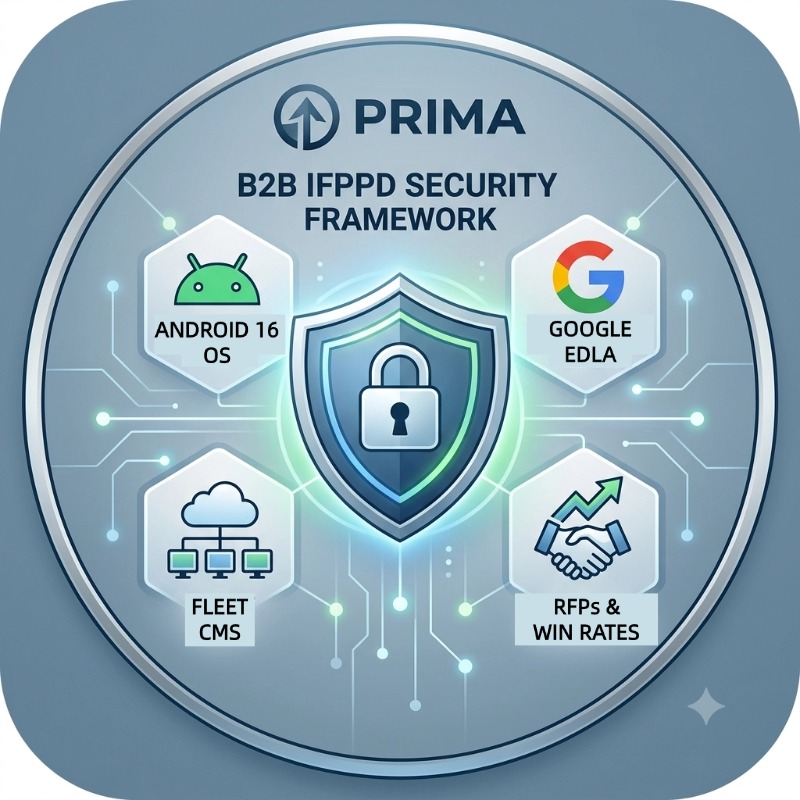
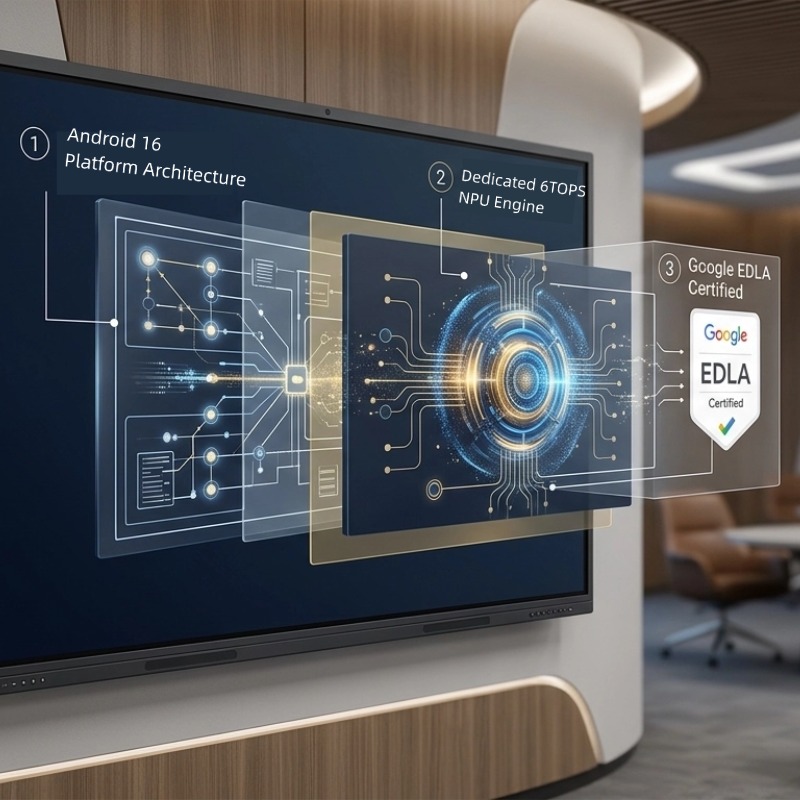
In modern commercial display engineering, software security and official compliance cannot be evaluated in isolation. They operate in a tightly integrated, hardware-to-software synergy. For B2B distributors pitching to security-conscious enterprise clients, articulating this multi-layered defense mechanism is the key to decoupling conversations from price-wars and shifting them toward long-term platform value.
1. The Digital Backbone: Android 16 Native Architecture
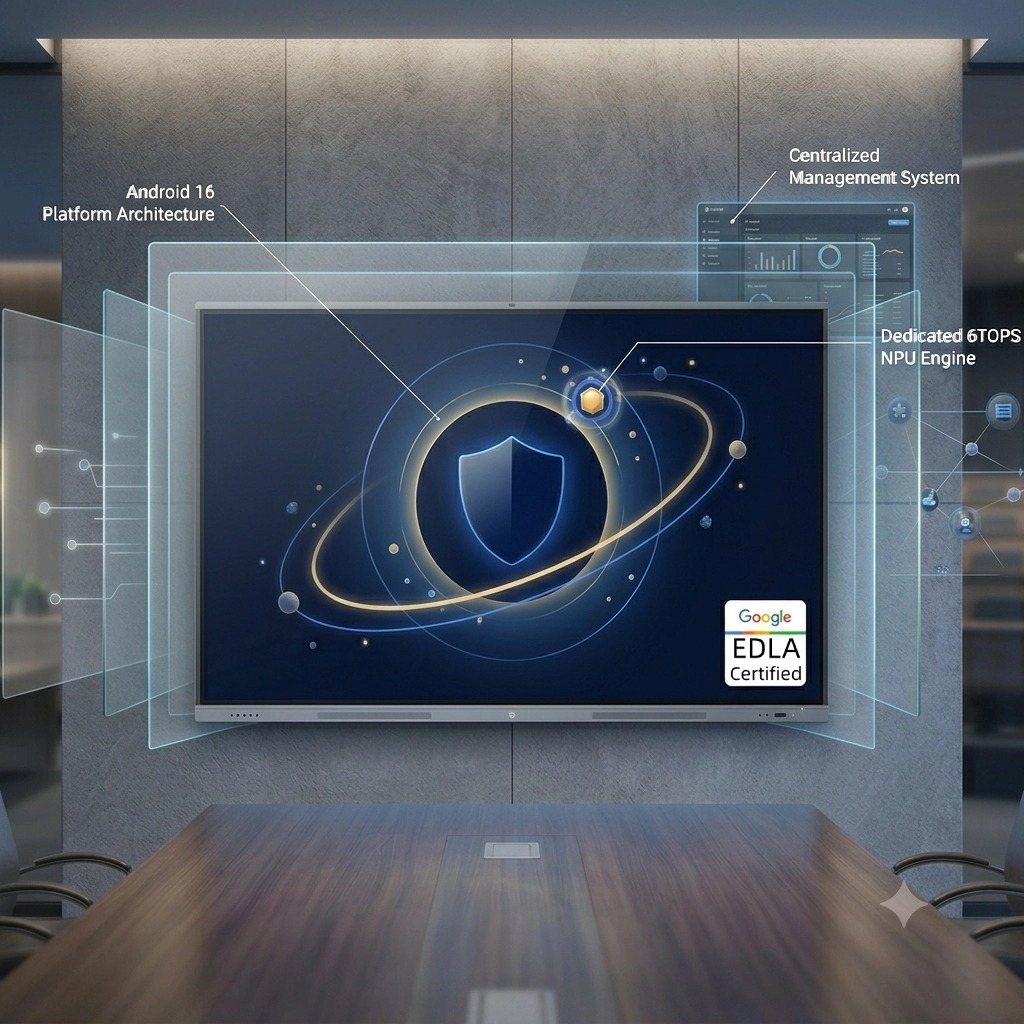
Android 16 delivers the underlying, foundational security architecture at the OS level. It defines the mathematical and cryptographic rules of the display:
Advanced Scoped Storage and Sandbox Isolation: Android 16 enforces strict hardware-level isolation between applications. Enterprise data pipelines and user credentials cannot be monitored or scraped by malicious background processes, ensuring zero cross-contamination during multi-user hot-desking sessions.
Cryptographic Credential Protection: The platform utilizes upgraded hardware-backed keystore systems to encrypt user tokens, facilitating secure, enterprise-grade Single Sign-On (SSO) integration.
2. The Official Gateway: Google EDLA Validation
While Android 16 creates the robust defensive ground, Google EDLA certification acts as the official validation layer and regulatory key. Android 16 provides the secure capability; EDLA guarantees that these native security protocols are strictly enforced and legally compliant.
Continuous Threat Mitigation: EDLA mandates server-side malware monitoring via Google Play Protect, running real-time cloud background scans to intercept malicious endpoints before they breach the institutional domain.
Official Cloud Synchronization: It grants verified, secure access to the native Google Workspace for Education and corporate cloud ecosystems, allowing users to log in natively via official enterprise credentials without the critical network liabilities of sideloading unverified third-party APKs.
Fleet Optimization and Commercial Monetization via Hybrid Local/Cloud CMS Architecture
Securing the endpoint is only half the operational equation; the real commercial value for distributors and large-scale enterprises lies in day-to-day fleet synchronization. An integrated Centralized Management System (CMS) transitions the PRIMA SA6J Series from an isolated piece of hardware into a scalable, networked infrastructure.
Crucially, PRIMA utilizes a flexible hybrid local (LAN) and cloud-based CMS deployment matrix. For ultra-secure government agencies, military commands, or research universities requiring absolute physical isolation, the CMS can be deployed locally on-premise over a closed Local Area Network (LAN)—ensuring zero external data leakage. Conversely, for distributed corporate campuses, multi-site school districts, or global channel partners, the cloud-based CMS architecture opens up borderless remote administration.
Rather than dispatching IT technicians to manually flash firmware room-by-room, this hybrid architecture allows for comprehensive remote administration from a single centralized dashboard. For distributors, this introduces a massive commercial paradigm shift: it allows channel partners to transition from low-margin one-time hardware sales into recurring, high-margin Managed Service Provider (MSP) contracts—remotely hosting and managing the fleet infrastructure via the cloud on behalf of school districts or corporate clients who lack dedicated internal IT staff.
Fleet Management Challenge
Legacy Manual Intervention
NPU & Hybrid CMS-Accelerated Automation (LAN / Cloud)
Firmware & Security Patching
Individual USB flashing; causes high labor overhead and delayed vulnerability patches.
Automated, scheduled Over-The-Air (OTA) batch updates executed during off-peak hours via local LAN servers or the cloud.
Application & Provisioning
Manual sideloading of APKs; high risk of malware introduction and version fragmentation.
Centralized application deployment and silent installation via certified enterprise or private local repositories.
Power & Sustainability Auditing
Over-night idling due to user neglect; shortens panel lifespans and inflates electricity bills.
Remote power scheduling, real-time diagnostic reporting, and automated energy policy enforcement across all subnets.
Mitigating Risk and Maximizing B2B Contract Win Rates
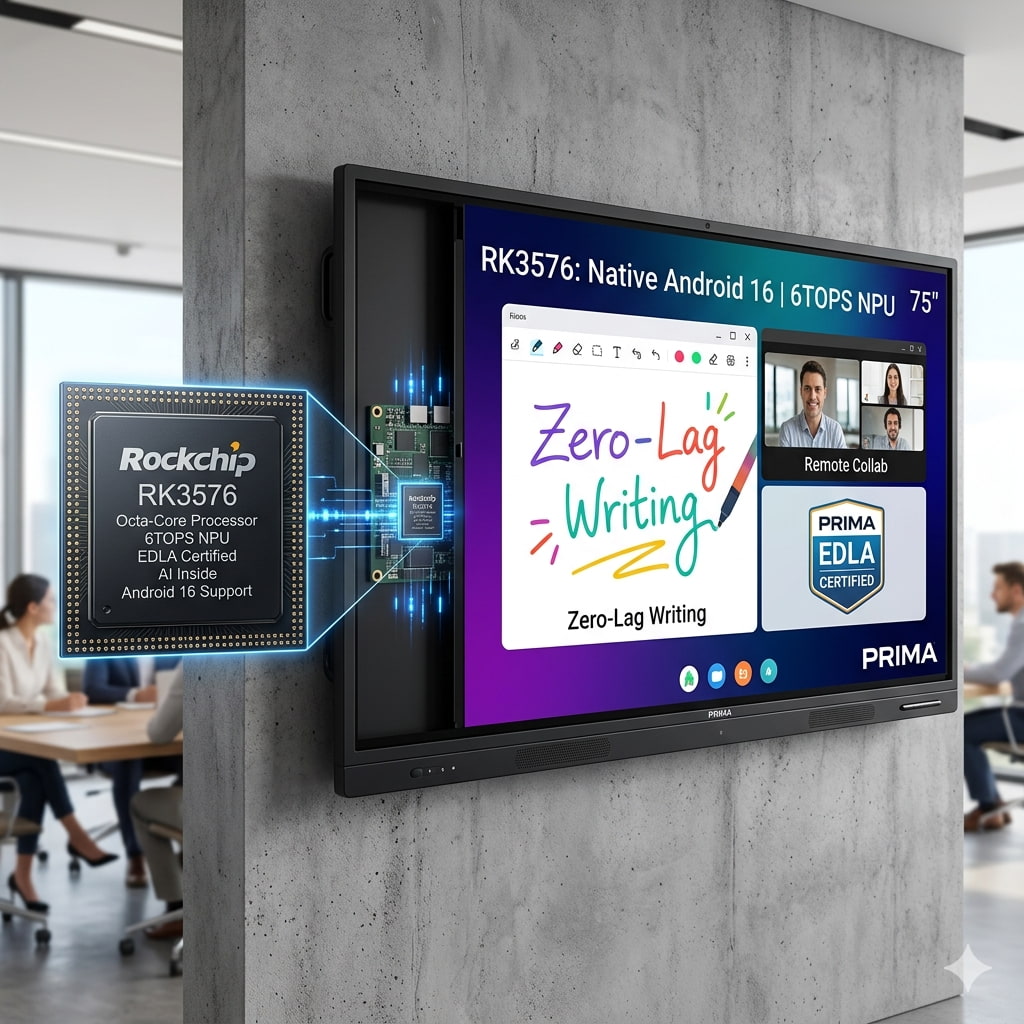
As a dedicated B2B commercial display manufacturer, PRIMA engineers platforms that deliberately eliminate friction across the entire supply chain. Proposing a future-proof architecture like the PRIMA SA6J Series (Rockchip RK3576 / Android 16 / EDLA / Hybrid CMS) delivers distinct structural protections for distributors and integrators:
Accelerated Procurement Cycles: When bidding on complex government or corporate RFPs, uncertified hardware often triggers lengthy, multi-month security audits by institutional network teams. Presenting an EDLA-certified solution with dual LAN/Cloud server deployment capabilities bypasses these compliance hurdles immediately, drastically reducing sales cycles for distributors.
Post-Sale Margin Protection: By empowering clients or channel partners with remote diagnostic capabilities via the CMS, the frequency of low-value, high-cost technical onsite interventions (truck rolls) is reduced by up to 70%. Hardware instability, application crashes, and configuration errors are resolved over the cloud or private network before they can degrade the client's daily workflow.
Elimination of Technical Obsolescence: Combining a 6TOPS NPU for ultra-low latency processing with the modern lifecycle of Android 16 ensures the hardware remains fully compatible with third-party software updates until 2030, safeguarding the distributor’s brand reputation against premature hardware depreciation.
By delivering the precise balance of elite edge-AI compute power, structural data privacy, and global network deployment flexibility, PRIMA ensures its global B2B distribution networks can confidently conquer any enterprise RFP and secure long-term commercial growth.
🌐 Technical Directory & Compliance FAQ
Q1: What is the technical difference between the security roles of Android 16 and Google EDLA on the PRIMA SA6J Series?
A: Android 16 and Google EDLA operate in a complementary, hardware-to-software synergy. Android 16 provides the foundational security architecture, implementing hardware-level application sandboxing (Advanced Scoped Storage) and cryptographic encryption via upgraded keystore systems to protect user tokens. Google EDLA acts as the enforcement and validation layer; it guarantees these native security protocols are uncompromised, mandates continuous cloud-based malware scanning via Google Play Protect, and unlocks secure, native Single Sign-On (SSO) access to the official Google Workspace ecosystem without the network risks of sideloading unverified third-party APKs.
Q2: Does the PRIMA SA6J Series CMS require an active internet connection to execute fleet management?
A: No. The PRIMA SA6J Series utilizes a flexible hybrid CMS architecture. For high-security environments requiring absolute physical data isolation (such as government installations or private enterprises), the CMS can be deployed entirely on-premise over a closed Local Area Network (LAN) with zero external internet dependencies. For multi-site configurations or remote value-added technical support, the system can switch to a cloud-based CMS deployment model.
Q3: How does the hybrid CMS topology help B2B distributors lower technical support costs and generate recurring revenue?
A: By leveraging the cloud capabilities of the hybrid CMS, distributors can act as Managed Service Providers (MSPs), signing lucrative remote maintenance contracts with clients. This enables technical teams to troubleshoot software, update firmware, and optimize settings remotely from their corporate headquarters—eliminating low-value physical tech deployments (truck rolls) by up to 70%. For clients with strict offline policies, the local LAN management option allows the distributor to easily train the end-user's in-house IT team, mitigating downstream warranty liabilities.
Q4: Why is the Rockchip RK3576 platform's 6TOPS NPU critical for institutional data privacy and TCO reduction?
A: The dedicated 6TOPS Neural Processing Unit (NPU) inside the PRIMA SA6J Series processes specialized machine learning workloads—such as handwriting vectorization and acoustic voice tracking—locally at the hardware edge. By running these advanced algorithms locally on the NPU instead of routing data streams to external cloud servers, institutional data privacy is completely preserved. Furthermore, offloading these complex computations away from the primary CPU prevents processor saturation and high thermal spikes, significantly extending the physical lifecycle of the panel and lowering the total cost of ownership (TCO).
Read More
 Web
Web





 IPv6 network supported