From Hybrid Learning to Smart Collaboration: Maximizing Workplace and Classroom Engagement in 2026
Jun 30, 2026
For years, the procurement of Interactive Flat Panels (IFPDs) followed a predictable trajectory: schools and enterprises invested thousands of dollars in large-format touchscreens, only for these advanced computational platforms to be relegated to glorified, over-specified projectors or reactive digital whiteboards. The hardware arrived with elite processing potential, yet the daily user experience remained shackled by manual file transfers, disconnected cloud accounts, and distracting touch latency that disrupted the natural flow of human teaching and collaboration.
In 2026, that era of underutilized hardware is officially over. The transition from passive presentation to active, frictionless immersion requires a fundamental shift in how hardware and software interlock. By harnessing the native capabilities of Android 16, official Google EDLA (Enterprise Device Licensing Agreement) integration, and localized 6TOPS NPU edge computing, the PRIMA SA6J Series does not just display content—it orchestrates an interconnected ecosystem. For B2B distributors and educational/corporate buyers, this shifts the narrative from selling mere physical glass to delivering a comprehensive, modern collaboration framework.
Frictionless Ecosystem Integration: Banishing the USB Flash Drive
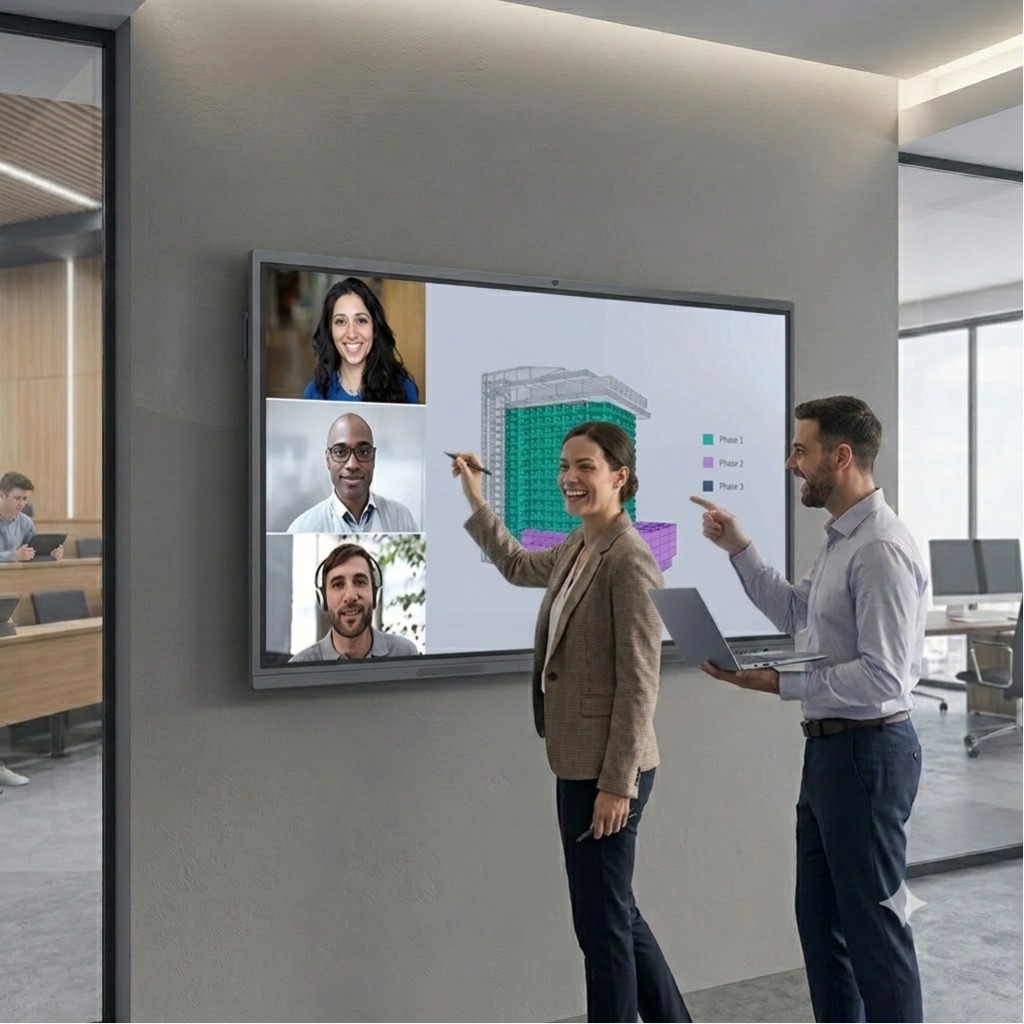
In a fast-paced classroom or executive boardroom, momentum is everything. The traditional ritual of a guest speaker or educator walking up to an IFPD, fumbling with a USB flash drive, struggling with cross-platform formatting issues, or attempting to type complex cloud passwords on a public screen is a major engagement killer. It introduces critical security risks and drains valuable collaborative time.
With native Google EDLA validation integrated into the PRIMA SA6J Series, the interactive display shifts from an isolated hardware silo into a seamless, trusted extension of the institution's primary cloud environment.
Native Account Synchronization: Educators and corporate facilitators can walk up to any panel within the fleet and securely sign in via their official institutional credentials or a secure Single Sign-On (SSO) mobile prompt.
Instant Cloud Access: Within seconds, their personalized workspace—including custom wallpapers, individual app layouts, and direct access to Google Classroom, Google Workspace, Microsoft OneDrive, and native cloud drives—is rendered instantly.
Zero-Sideloading Compliance: Because the Google Play Store is natively accessible and verified by Google Play Protect, users can pull down enterprise-grade collaborative applications, engineering viewers, or real-time polling tools directly from the cloud. No unsecured third-party APKs, no manual configurations, and no administrative friction.
Edge-AI Infused Interactive Performance: The NPU Writing Revolution
Even the most seamless cloud integration fails to engage an audience if the fundamental touch-and-ink experience feels unnatural. When multiple students stand at a board to solve an equation, or when product design teams sketch engineering modifications during a hybrid sprint, even a few milliseconds of digital ink lag causes immediate psychological disconnection. The brain notices the separation between physical intent and visual execution.
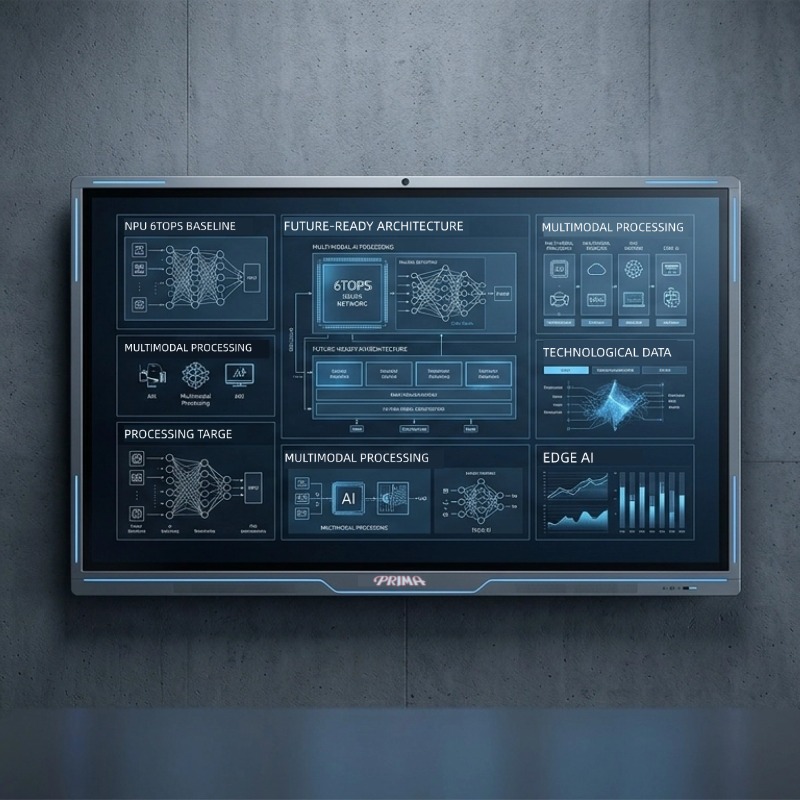
This is where the specialized 6TOPS Neural Processing Unit (NPU) on the Rockchip RK3576 platform shifts from a technical line item to a transformative experiential asset.
Traditional displays rely on a generalized CPU to track touch vectors, calculate coordinate pathways, and render digital ink—a pipeline heavily prone to stuttering when system tasks scale up. The PRIMA SA6J Series offloads these high-frequency mathematical calculations onto the dedicated hardware-level NPU engine.
Predictive Latency Reduction: The 6TOPS NPU runs deep-learning predictive stroke algorithms directly at the edge. By analyzing the vector, speed, and acceleration of the stylus or finger, the NPU mathematically anticipates the user's trajectory, reducing perceived ink latency to an absolute near-zero minimum. Writing on the panel feels as instantaneous and organic as graphite on textured paper.
True Multi-User Concurrency: Whether it is four students collaborating on an interactive STEM chart or a corporate project management team mapping an agile workflow, the dedicated NPU processes multi-point multi-user inputs simultaneously without degrading frame rates or dropping touch packets.
Commercial Enablement: Moving Distributors Beyond the Commodity Trap
For B2B distributors and commercial AV integrators, the scenario-driven superiority of the PRIMA SA6J platform completely rewrites the rules of market engagement. Competing solely on panel brightness, contrast ratios, or minor price concessions is a fast track to margin erosion.
By pivoting the commercial discourse toward high-impact, real-world deployment scenarios, channel partners can unlock far greater contract values:
Selling the Solution, Not the Component: Distributors can position the PRIMA SA6J platform not as a standalone display unit, but as a turnkey Modern Classroom/Workplace Transformation Package. It provides an instant hook for school district superintendents and enterprise COOs who are desperate to justify their digital transformation budgets with tangible usage metrics.
Mitigating Post-Implementation Disappointment: When hardware is difficult to use, adoption rates plummet, leading to buyer remorse and strained client relationships. Because the SA6J series mimics the intuitive user interfaces of the smartphones and tablets that users interact with daily, user adoption is immediate, drastically reducing post-sale training overhead and warranty complaints for the integrator.
Future-Proof Scale: Demonstrating how Android 16 and a 6TOPS edge-AI chip handle complex software updates ensures the client's investment remains viable for years to come. This elevates the distributor's status from a simple hardware vendor to a strategic, long-term technology advisor.
Technical & Performance FAQ
Q1: How does official Google EDLA certification improve the daily workflow for teachers and corporate presenters compared to standard uncertified open-source Android panels?
A: On uncertified open-source Android panels, users must rely on external laptops or dangerous third-party APK sideloading to access cloud materials, causing constant setup delays. Official Google EDLA certification on the PRIMA SA6J Series allows users to securely log into their official Google or Microsoft enterprise accounts directly on the display. It grants native, instant access to Google Classroom, Cloud Drive, and Workspace apps with real-time file synchronization, eliminating the need for external connection cables or vulnerable USB flash drives.
Q2: Why is a dedicated 6TOPS NPU required to achieve low-latency writing on the PRIMA SA6J Series?
A: Standard interactive displays handle touch detection through the main CPU, which often bottlenecks during complex multi-user interactions, resulting in visible ink lag. The PRIMA SA6J Series features a specialized 6TOPS Neural Processing Unit (NPU) that runs edge-AI predictive stroke models. By dedicatedly calculating finger/stylus vectors and predicting writing trajectories at the hardware level, the NPU bypasses CPU overhead to reduce touch latency to near-zero, maintaining flawless pen-to-glass fluidity even during heavy multi-user concurrent operation.
Q3: How does the integration of Android 16 optimize multi-user corporate hot-desking or multi-classroom rotation?
A: Android 16 introduces advanced user-profile sandboxing and strict scoped-storage rules native to the operating system. When multiple educators or corporate teams rotate through a single room and log into their respective cloud profiles on the PRIMA SA6J display, Android 16 ensures that cached credentials, search history, and private cloud session tokens from the previous user are entirely isolated and cryptographically protected, preventing unauthorized data access or cross-contamination.
Read More
 Web
Web





 IPv6 network supported