What is an NPU? How Edge-AI Processing is Revolutionizing Modern Smart Environments
Jun 10, 2026
In the vocabulary of commercial display procurement, acronyms like CPU and GPU have reigned supreme for decades. Buyers naturally check the number of processing cores and graphics frequencies when evaluating interactive flat panels (IFPDs). However, as classrooms and corporate boardrooms transition from passive whiteboards to intelligent collaboration hubs, traditional processing architectures are hitting a physical performance wall.
Enter the Neural Processing Unit (NPU). In 2026, dedicated Edge-AI processing has shifted from an experimental premium feature to an foundational infrastructural requirement. For institutional IT decision-makers, understanding the role of an NPU is the key to decoupling system longevity from computational lag. For system integrators, leveraging NPU-driven hardware is the most reliable way to pitch an future-proof ecosystem that minimizes post-sale support and operational downtime.
Understanding the Architecture: CPU, GPU, and the Rise of the NPU
To appreciate why a dedicated NPU is vital for next-generation IFPDs, it is necessary to examine how computational workloads are distributed across a commercial display's chipset.
The CPU (Central Processing Unit): Designed as a general-purpose processor, the CPU executes sequential logic. It manages the background operating system threads, handles storage data formatting, and launches applications. While highly versatile, the CPU is highly inefficient when tasked with handling thousands of small, simultaneous mathematical calculations required by artificial intelligence.
The GPU (Graphics Processing Unit): Built for parallel processing, the GPU excels at rendering pixels, driving 4K user interfaces, and decoding high-definition video streams.
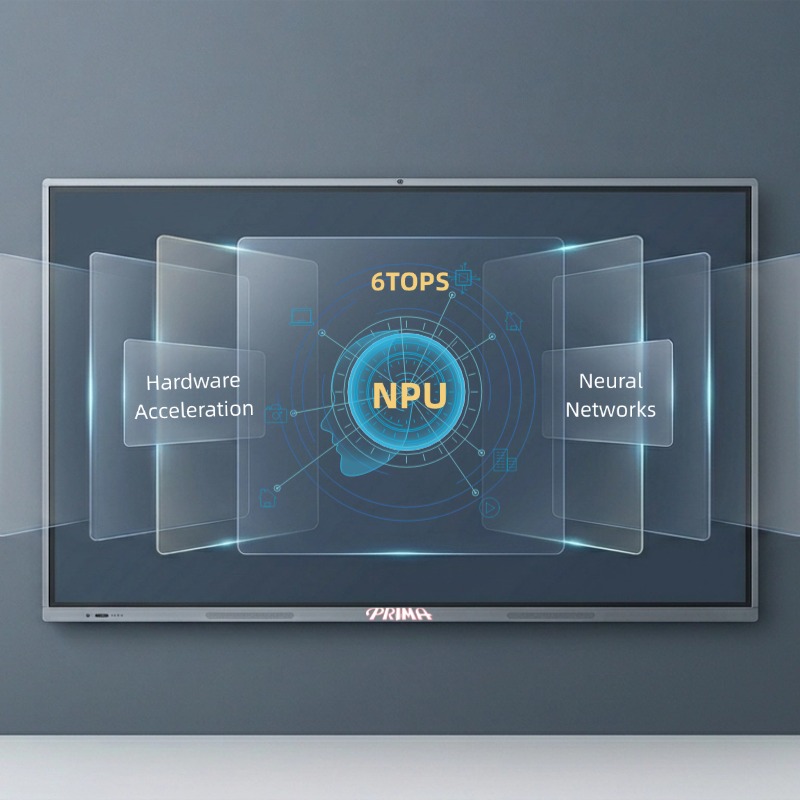
The NPU (Neural Processing Unit): Unlike general compute cores, an NPU is an ASIC (Application-Specific Integrated Circuit) engineered specifically to accelerate machine learning algorithms and neural networks. By executing matrix multiplication at hardware-level speeds, the NPU processes complex data streams—such as voice tracking, handwriting vectorization, and video analytics—with a fraction of the power consumption required by a traditional CPU.
When an IFPD relies solely on a CPU/GPU architecture to run modern AI features, the processor quickly saturates. The result is high thermal spikes, system throttling, and severe touch or ink latency. A dedicated NPU solves this by completely isolating AI tasks from primary operating system operations.
Real-World Scenarios: How a 6TOPS NPU Transforms Daily Operations
Integrating an advanced platform like the Rockchip RK3576—which features a dedicated 6TOPS (Trillion Operations Per Second) NPU engine—fundamentally changes the interactive experience in educational and corporate settings.
1. Ultra-Low Latency Handwriting and Graphical Vectorization
In a smart classroom, multi-user collaboration often causes legacy panels to lag. When multiple students write simultaneously, a standard CPU struggles to convert raw touch-point coordinates into smooth vector graphics in real-time. A dedicated NPU processes handwriting recognition algorithms instantly at the edge. It predicts touch trajectories and smooths digital ink loops with ultra-low latency, delivering a natural, pen-on-paper writing experience even during intensive multi-student annotation sessions.
2. Multi-Device Wireless Casting and Network Stability
Modern hybrid environments require panels to handle concurrent wireless streams from laptops, tablets, and smartphones. When running multi-screen casting alongside active mirror protocols, legacy CPUs often throttle, causing dropped frames and pixelated feeds. The NPU handles network packet optimization and intelligent data prioritizing, ensuring smooth 4K screen mirroring without placing a computational burden on the core operating system.
3. Edge-AI Audio-Visual Tracking in Hybrid Rooms
In corporate meeting spaces, seamless hybrid communication demands real-time hardware adaptation. A 6TOPS NPU enables native, hardware-level voice localization and dynamic camera tracking. The display can instantly isolate the active speaker’s voice from classroom background noise and automatically frame the presenter, all processed locally on the device without sending data to the cloud, safeguarding institutional privacy compliance.
The Strategic Alignment: TCO Mitigation and Integrator Advantages
The operational shift from software-emulated AI to hardware-accelerated NPU processing yields measurable commercial advantages across the entire B2B value chain.
Operational Challenge
Software-Emulated AI (Legacy Hardware)
NPU-Accelerated Hardware (RK3576 Platform)
System Thermal Management
CPU runs at 100% capacity; causes high heat, component degradation, and hardware failure.
AI tasks offloaded to NPU; CPU remains cool, expanding hardware life cycles.
User Interface Responsiveness
UI stutters or drops frames when running background smart analytics.
Fluent, consistent 60fps UI performance regardless of active background AI workloads.
Post-Sale Maintenance (Integrators)
Frequent firmware patches required to optimize poorly distributed software processing.
Stable, hardware-separated computing that drastically reduces service truck rolls.
For system integrators, bidding on government or institutional tenders with an NPU-driven design represents a massive competitive advantage. It allows you to guarantee long-term operational speed and cross-platform application stability without requiring complex active cooling modifications or premium software licensing overheads.
Engineering Precision for Every Market Tier
As a dedicated B2B commercial display manufacturer, PRIMA aligns its component engineering to match diverse target markets and project budgets without compromising structural integrity:
The Premium AI-Optimized Tier (The All-New PRIMA SA6J Series): Built upon the Rockchip RK3576 platform, incorporating a native 6TOPS NPU, Android 16, and official Google EDLA certification. This tier is meticulously engineered for high-security corporate networks, advanced university lecture halls, and environments demanding elite multi-tasking capabilities.
The Mainstream Volume Tier: Powered by trusted industry baselines like the HiSilicon V610 platform. This series delivers exceptional everyday stability and high cost-efficiency for mass-volume school tenders that require reliable digital whiteboarding and centralized control without premium edge-AI processing costs.
By separating hardware capabilities into distinct architectural strengths, PRIMA ensures its distribution networks and integration partners can confidently address any RFP, secure in the knowledge that their hardware provider delivers the precise balance of performance, budget compliance, and long-term security.
Read More
 Web
Web





 IPv6 network supported